
Structural Damage vs. Foundation Problems: How to Tell the Difference
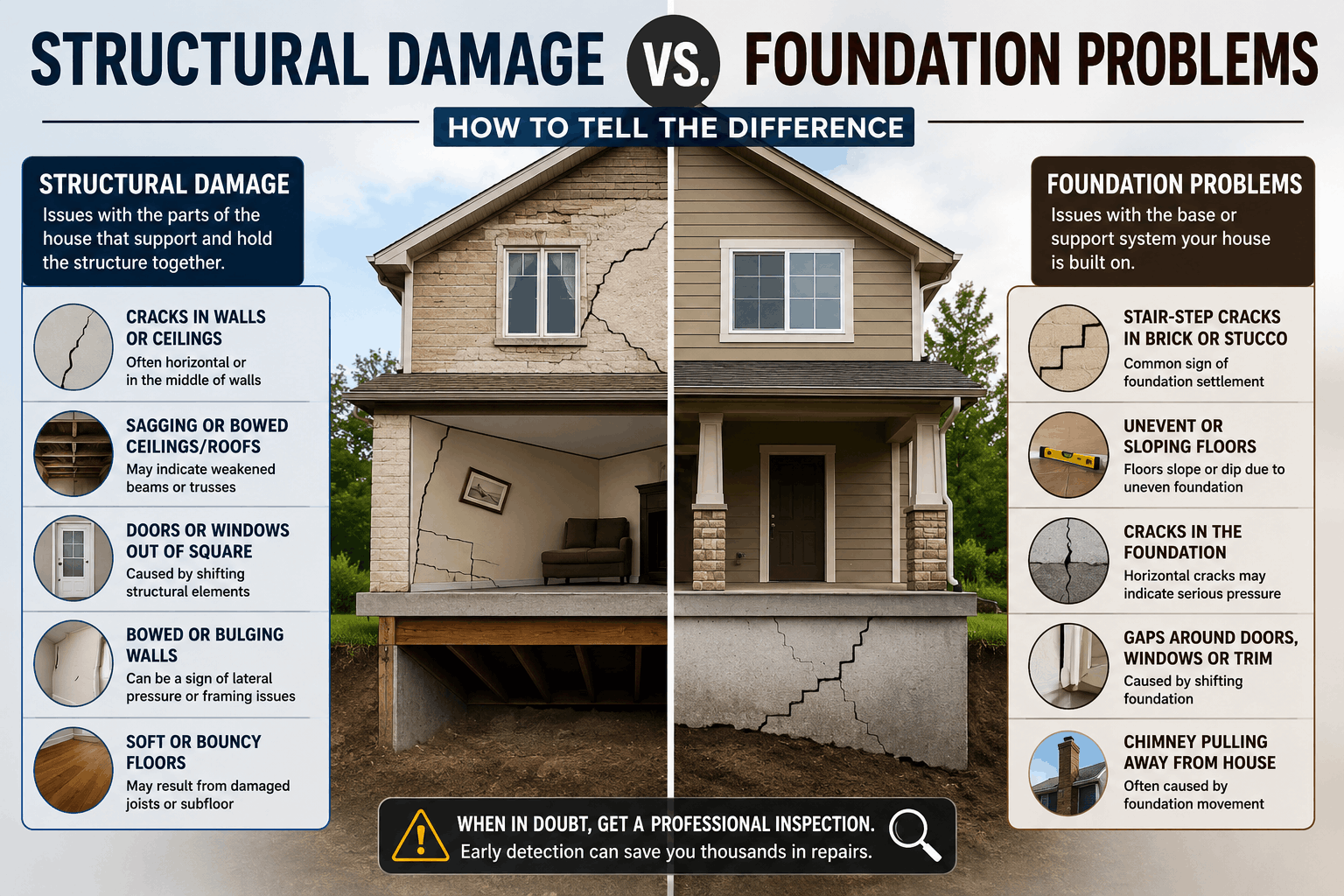
Structural Damage vs. Foundation Problems: How to Tell the Difference
If you’ve noticed a crack in your wall, a door that won’t close properly, or a floor that seems to slope ever so slightly, you’ve probably found yourself searching online late at night trying to figure out what’s going on with your home. Two terms tend to come up again and again in these searches: “structural damage” and “foundation problems.” Homeowners often use them interchangeably, but they are not the same thing — and knowing the difference can save you thousands of dollars and a lot of unnecessary stress.
In this guide, we’ll break down exactly what separates structural damage from foundation problems, the warning signs of each, which one typically needs attention first, how one can actually cause the other, and — most importantly — when it’s time to stop Googling and pick up the phone to call a professional.
Are Foundation Problems and Structural Damage the Same Thing?
The short answer is no. The longer answer is that they’re closely related, which is exactly why people confuse them.
Foundation problems refer specifically to issues with the base of your home — the concrete slab, footings, piers, or crawl space supports that everything else sits on. When we talk about foundation issues, we’re talking about settling, shifting, heaving, or cracking in that base layer. Foundations move when the soil beneath them moves, when water saturates or dries out the ground unevenly, or when the original construction didn’t account for the soil conditions on the lot.
Structural damage, on the other hand, is a broader term. It refers to any compromise in the parts of a building that bear weight and hold the structure together — this includes load-bearing walls, beams, joists, trusses, and yes, the foundation as well. Structural damage can originate from a foundation issue, but it can also come from completely unrelated causes: water damage to framing, termite or pest infestation that has eaten through wood supports, a poorly executed renovation that removed a load-bearing wall without proper support, fire damage, or even age-related wear on materials.
Think of it this way: foundation problems are one specific category of structural damage, but not all structural damage stems from the foundation. A homeowner could have serious structural damage in their roof trusses from water intrusion with a perfectly healthy foundation underneath. Conversely, a home could have early-stage foundation settling that hasn’t yet caused any damage to the structure above it.
Understanding this distinction matters because the diagnostic approach — and the repair — is different depending on where the actual problem lives.
What Symptoms Indicate Each Issue?
Because foundation problems and structural damage often produce overlapping symptoms, it helps to know which signs point more strongly toward one or the other.
Signs That Point to Foundation Problems
- Diagonal cracks near corners of windows and doors. These “stair-step” cracks, especially in brick or stucco, are a classic indicator that the foundation beneath is settling unevenly.
- Doors and windows that stick or won’t latch. If a door used to close fine and now drags on the frame, the foundation may have shifted enough to throw the frame out of square.
- Uneven or sloping floors. A floor that visibly dips toward one side of the house, or where a marble rolls consistently in one direction, often signals differential settling.
- Gaps between the wall and ceiling, or wall and floor. These gaps appear as the foundation moves and pulls the structure with it.
- Cracks in the foundation itself, particularly horizontal cracks (which can indicate pressure from soil or water) or cracks wider than a quarter inch.
- A chimney leaning away from the house. Because chimneys often have separate footings, foundation movement can cause them to pull away from the main structure.
Signs That Point to Structural Damage (Beyond the Foundation)
- Sagging rooflines or visibly bowed ceilings, which often point to weakened trusses or rafters rather than foundation movement.
- Cracks running through the middle of a wall (rather than from corners of openings), which can indicate a failed beam or header above.
- Soft, spongy, or bouncy floors — particularly common with rotted joists from long-term moisture exposure rather than foundation settling.
- Visible wood damage, such as crumbling, hollow-sounding wood (a sign of termites) or discoloration and softness (a sign of water damage).
- Bowing or bulging walls, especially in basements, which can indicate lateral pressure issues separate from vertical settling.
- Cracks that appear suddenly after a renovation, which often point to a load-bearing element that was altered without proper structural support.
Of course, many homes show a mix of both. A long-neglected foundation problem can eventually create structural symptoms throughout the house, which is part of why an accurate diagnosis really does require a trained eye rather than a checklist alone.
Which Should Be Repaired First?
In almost every case, foundation problems need to be addressed before any other structural repairs — and there’s a simple reason why: the foundation is what everything else depends on.
If you repair a sagging beam, patch drywall cracks, or replace damaged framing while the foundation underneath continues to shift, you’re essentially repairing symptoms while ignoring the cause. Within months or a couple of years, the same cracks and damage will reappear, because the underlying movement hasn’t stopped. This is one of the most common and costly mistakes homeowners make — paying to fix cosmetic or structural symptoms without stabilizing the foundation first, only to repeat the repair later.
The general order of operations should be:
- Diagnose and stabilize the foundation. This might involve underpinning, piering, slab leveling, or addressing drainage and soil moisture issues that are causing the movement.
- Allow the structure to settle (if recommended by your contractor) before finalizing cosmetic repairs, since some minor shifting may continue briefly even after stabilization.
- Repair structural elements affected by the movement — beams, joists, framing, or trusses that were compromised.
- Address cosmetic damage last — drywall cracks, paint, flooring, and trim.
There are exceptions. If structural damage is unrelated to the foundation (say, termite damage in the attic while the foundation is solid), that issue should obviously be handled on its own timeline and doesn’t need to wait. The key principle is simply: don’t finish fixing what you can see until you’ve confirmed the foundation supporting it is stable.
Can One Problem Cause the Other?
Yes, and this relationship runs in both directions, though one direction is far more common.
Foundation problems causing structural damage is by far the more frequent scenario. When a foundation settles unevenly, shifts, or heaves, the weight distribution across the entire home changes. Walls that were designed to bear load evenly suddenly carry uneven stress. Over time, this can crack load-bearing walls, twist door and window frames out of square, cause beams to bow, and even crack ceiling joists. Left unaddressed for years, foundation movement can compromise the structural integrity of the entire home, not just the slab or footings.
Structural damage causing foundation problems is less common but does happen. For example, severe water damage from a roof leak that goes undetected for years can eventually direct excess moisture down through walls and into the soil around the foundation, contributing to soil expansion and uneven settling. Similarly, an improperly removed load-bearing wall can shift weight distribution in a way that places unexpected stress on certain points of the foundation, accelerating cracking or settlement in that specific area.
This two-way relationship is exactly why a comprehensive inspection matters. Treating only the obvious symptom — say, patching a crack in a wall — without investigating whether a foundation issue caused it (or whether the crack itself is contributing to a developing foundation issue via water intrusion) can lead to a cycle of repeated, expensive repairs that never actually solve the underlying problem.
When Should Homeowners Call an Expert?
Some cracks and quirks are completely normal in a home that’s a few years old — minor drywall cracks from seasonal humidity changes, for instance, rarely indicate anything serious. But there are specific warning signs that should prompt a call to a professional rather than a trip to the hardware store for caulk.
Call an expert if you notice:
- Cracks wider than a quarter inch, especially if they’re growing over weeks or months
- Doors or windows that have become difficult to open or close within the last several months
- A floor that has visibly started to slope or feels different underfoot than it used to
- Cracks that appear in a “stair-step” pattern, particularly near corners
- Standing water or consistent moisture near your foundation after rain
- Visible separation between an exterior wall and the foundation
- A sagging roofline or ceiling that wasn’t there a year ago
- Any structural changes after a major storm, earthquake, or nearby construction/excavation
It’s also worth getting a professional opinion before buying a home with any of these signs, and before starting any renovation that involves removing or altering walls — even if you don’t think they’re load-bearing. A qualified contractor can use tools like laser levels, moisture meters, and soil testing to determine whether what you’re seeing is cosmetic, foundation-related, or true structural damage, and can map out the right order of repairs so you’re not paying twice for the same problem.
If you’re in the East Bay and need a second opinion or a full inspection, working with an experienced Structural Repair Contractor Berkeley team means you get both a foundation specialist and a structural eye in one assessment — rather than guessing which type of contractor to call first.
The Bottom Line
Foundation problems and structural damage are related but distinct issues, and getting the order of diagnosis and repair right matters just as much as the repair itself. Foundation issues are almost always the root cause when both types of symptoms appear together, which means stabilizing the foundation should come first, structural repairs second, and cosmetic fixes last. If you’re seeing any of the warning signs above — sticking doors, stair-step cracks, sloping floors, or a sagging roofline — don’t wait for it to get worse. A professional assessment now is almost always cheaper than a major repair later.